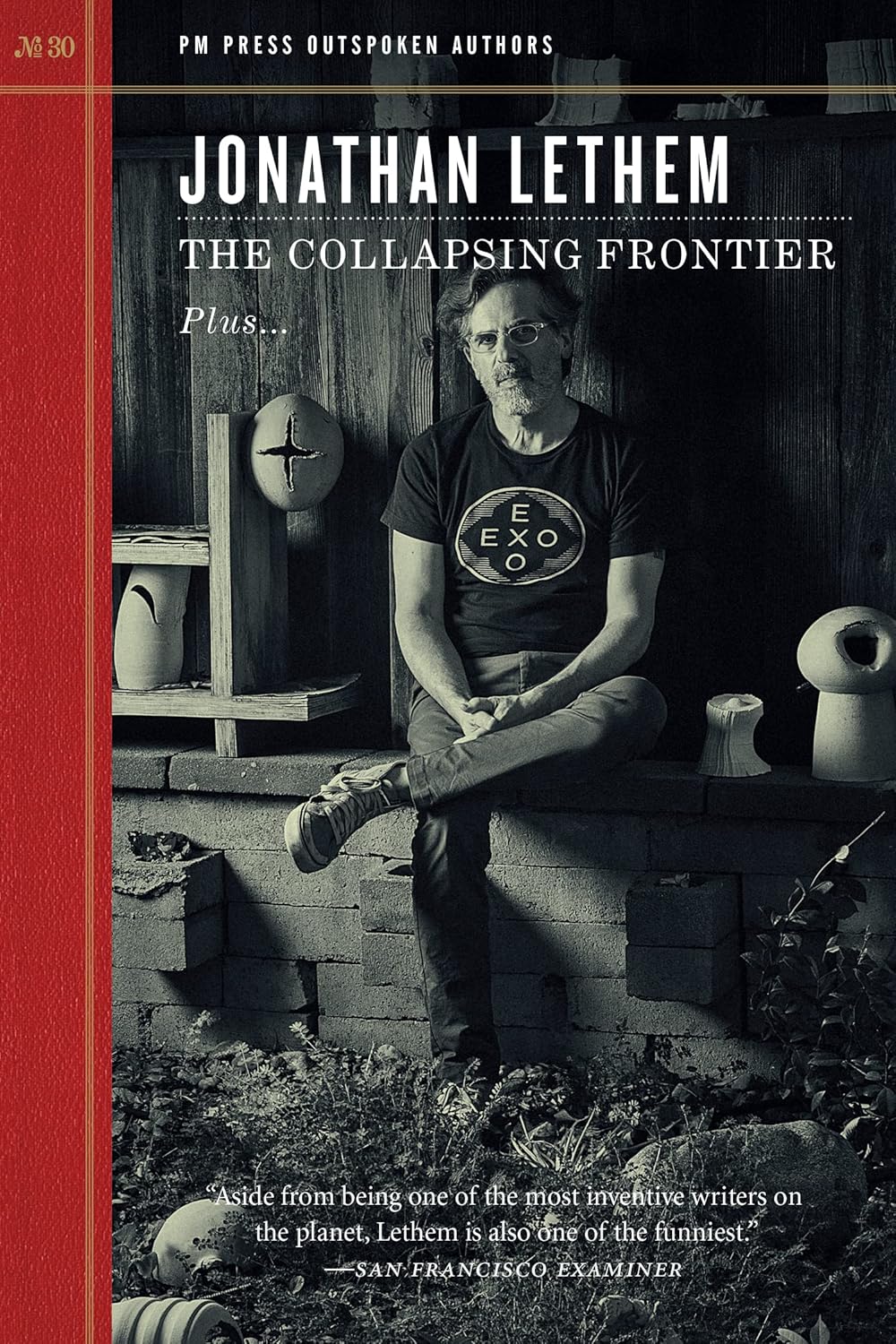
THE COLLAPSING FRONTIERBy Jonathan LethemPM Publishing978-1-62963-488-3158pp/$16.00/March 2024 |
|
Reviewed by Steven H Silver
Although perhaps best known for his novels and short fiction, Jonathan Lethem has also published a large amount of non-fiction essays, some of which have been collected in The Disappointment Artist and The Ecstasy of Influence. The Collapsing Frontier, part of PM Press's Outspoken Authors series, is also a collection of essays (plus the short stories "The Collapsing Frontier" and "In Mugwump Four") that serves as a sampler for this side of Lethem's career.The collection opens with "David Bowman and the Furry-Girl School of American Fiction." Lethem notes in this piece that he has a reputation for championing lesser known authors, both living and dead. Bowman was a friend of Lethem's who published two novels and a book of music criticism, as well as various essays, before his death. This essay was originally published as the introduction to Bowman's third novel, the posthumously published The Big Bang. If Lethem champions lesser known authors, this essay outlines how a lesser known author, Bowman, built a friendship and championed Jonathan Lethem in the early years of his career, even as Bowman, himself, was struggling to establish himself. It serves as not only an introduction to the novel, but as a eulogy to a friendship, both due to Bowman's death as well as the fact that Bowman had a difficult personality that caused him to burn bridges and cut people out of his life.
"Snowden in the Labyrinth" is billed as a review of Edward Snowden's memoir Permanent Record, and, to some extent, it is. However, it serves as an opportunity for Lethem to use Snowden's book about his activities working for the U.S. Government and eventual decision to reveal the breadth and depth of the government's surveillance of its own citizens as a way of looking at what it means to be part of society in the twenty-first century when privacy can no longer be assumed and everyone is complicit in leaking their own information. Lethem does provide insight into Snowden's book, noting that the portion covering the part of his life that was public is when the book begins to fall apart, but it almost feels as if the review of the book is secondary to Lethem.
Originally published in The New Yorker in 2022 as "Narrowing Valley," "The Collapsing Frontier" is a response to R.A. Lafferty's 1966 story "Narrow Valley." While it isn't necessary to read the Lafferty story to enjoy Lethem's response to it, knowing the story does add depth and background to what Lethem is doing. "The Collapsing Frontier" is less of a story, but rather an author's musings on creating a story using an earlier work as a basis. The family depicted, or considered, in "The Collapsing Frontier" is clearly based on the family in "Narrow Valley," although it is never described well enough to show a one-to-one correlation. The author in "The Collapsing Frontier" also brings a more modern sensibility to the story than Lafferty had, considering including a form of land acknowledgement in the story. Not only is the author aware of the planning stages of the story, but the story being considered also seems to achieve a sense of sentience, taking the author's considerations to an irrational conclusion.
One feature of PM Press's Outspoken Authors series is that the books included an interview with the author conducted by series editor Terry Bisson. The interview with Lethem is called "Rooms Full of Old Books Are Immortal Enough for Me." Bisson covers a variety of topics, from Lethem's MacArthur Grant to his teaching chair at Pomona College to his early self-promotion and goals as an authors. In light of the non-fiction essays in The Collapsing Frontier, which invariably are self-revelatory, one of Lethem's answers addresses that very topic. He explains that often when writing about topics, he finds himself focusing on himself as a way of answering the unasked questions, "Why should this guy (Lethem) be spouting off on this topic and why should the reader pay attention to him?"
The year 2021 was the hundredth anniversary of Polish author Stanislaw Lem's birth, and Lethem decided to do a deep dive into Lem's work, which he describes in "My Year of Reading Lemmishly." Having discovered Lem at the age of 15, the author was an early influence on Lethem, but when he began to explore his works in earnest, Lethem discovered that he had only scratched the surface, partly because of the quality of translations available of Lem's work and partly because so much of Lem's work had never been translated into English. During his exploration, Lethem determined that there were at least five different "Stanislaw Lems" ranging from hard science fiction, like Solaris, to the postmodernist author of One Human Minute to the fabulist who wrote The Futurological Congress. The essay also discusses Lem's low opinion of Western science fiction, but also notes that just as Lethem had an incomplete understanding of Lem's work due to translation issues, the reverse applied to Lem's view of science fiction. In re-reading Lem, Lethem also discovered that beloved works no longer held their magic for him, notably Memoirs Found in a Bathtub, possibly because satire has a shelf life. Other works, of course, do stand up to re-reading and works he encounters for the first time speak to him. While much of the essay deals with Lethem's reaction to Lem's writing, it also serves as a catalog of Lem's writing and, to a lesser extent, his life.
In re-reading Italo Calvino's essay "lightness" in 2016, Lethem offers "Calvino's 'Lightness' and the Feral Child of History" as part of his response to the first election of Donald Trump, which he also dealt with in his novel, The Feral Detective. In this essay, which also discusses Jean-Luc Goddard's film Alphaville, Lethem is concerned with how artists should respond to the rise of fascism, pulling Calvino's imagery of Perseus defeating Medusa as a central metaphor. The artist must be aware of the evil, but rather than look at it, must hold it up for others to see. In the wake of Trump's election, he told his children that they were right to ridicule Trump, but wrong to believe that laughter could defeat him. In Calvino's case, the evil was in the form of Mussolini and the Nazis, but Lethem also raises the specter of the Richard Nixon of his own childhood.
The second of two stories in The Collapsing Frontier is "In Mugwump Four," an exploration of virtual reality and the reinforcement social media offers. The protagonist and his partner, Lucinda, have no interest in Mugwump 4, the virtual reality engine that so many of their friends are disappearing into. Instead, they live a relatively secluded life in the Italian countryside. The protagonist, however, feels the need to comment on virtual reality and decides to enter the program to issue a manifesto, leaving behind notes to help himself return to reality. He discovers that the instant gratification of people "orgasming" over his manifesto is addictive and he allows himself to explore the surreal world in which he finds himself. Eventually, he looks below the surface and realizes that while people love his manifesto, few have actually read it, focusing instead of the title, and he determines to return to reality, where he discovers things aren't as cut and dried as he thought.
Jonathan Lethem's bibliography includes numerous short stories, essays, collections, and novels, beginning with Gun, with Occasional Music through Brooklyn Crime Novel (as of 2025). However, there are numerous other, lesser known works which are not as obviously Lethem's (such as the memoir Believeniks!, which was pseudonymously written with Christopher Sorrentino as by "Harris Conklin" and "Ivan Felt." The brief "Secret Bibliography," which ends Collapsing Frontier provides information on some of these lesser known appearances by Lethem to help his readers track down some of his more esoteric writings, like "Mood Bender" and "The Happy Prince," which have only appeared in their original publication in Crank! and reprinted in The Best of Crank!.
| David Bowman and the Furry-Girl School of American Fiction | My Year of Reading Lemmishly | |
| Snowden in the Labyrinth | Calvino's "Lightness" and the Feral Child of History | |
| The Collapsing Frontier | In Mugwump Four | |
| "Rooms Full of Old Books Are Immortal Enough for Me" | Secret Bibliography |
| Purchase this book |
|
|
|
Paperback |
Kindle |