
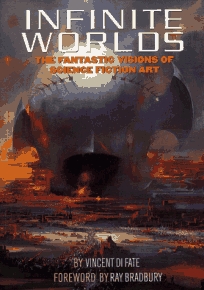
INFINITE WORLDSby Vincent di FatePenguin0-670-87252-0320pp/$45.00/1997 |
|
Reviewed by Steven H Silver
One of the nicest features of Science Fiction Age and Realms of Fantasy magazines are their full coler artist articles in each issue. These features have a fantasy or science fiction author profile one artist with accompanying illustrations from the artist's portfolio. Vincent di Fate's examination of art in science fiction, Infinite Worlds: The Fantastic Visions of Science Fiction Art is, in many ways, the book version of these profiles.
Di Fate begins his study with a 100-page history of science fiction art, looking at the scientific work of Leonardo da Vinci before really getting into the world of SF artwork with comics and the pulps. Although the history is well-written, it is also obviously only a cursory look at the topic, one which could have an entire book devoted to it.
The main part of the book, which most resembles the artist gallery features of the aforementioned magazines, is an alphabetical listing of several science fiction (not fantasy) illustrators. In most cases, these cover a two-page spread with a short biographical description of the artist's career and several examples of their art. Although the alphabetical structure makes it easy to find a particular artist, there is an index which would serve the same purpose. The book would have been, perhaps, a stronger reference tool if it had been more chronologically structured to permit the reader to see, more easily, the advances in artistic techniques within the field.
The book is by no means complete. Julie Bell is among the missing, as is David Cherry, Jill Baumann, and John Dismukes among others. At the same time, di Fate has elected to spend more than two pages on several artists. I can't fault di Fate on the decision to allot any of these artists the extra space, for instance Chelsey Bonestall or Michael Whelan, but adding a few of the neglected artists would have been nice as well.
There are a few minor mistakes, which are to be expected in a book of this sort. For instance, one painting by Bob Eggleton as having appeared in Science Fiction Age in 1976, a good fifteen years before that magazine was launched and eight years before Eggleton's own career began.
The color reproduction throughout Infinite Worlds is fantastic. Frequently book covers look better on the high-gloss paper than they do on the actual book cover. Furthermore, most of the artwork has lost the lettering which frequently obscures detail of the work when it appears in publication. If there is one problem with the design of the book, it would be that occasionally the text, particularly in footnotes, is a little too small to easily read.
Of course, di Fate's selection of paintings doesn't represent (nor claim to represent) each artist's best work. Instead, di Fate has selected each piece to represent an aspect of the artist's work, although even there questions occasionally arise. For instance, is there really such a difference between Don Maitz's cover for Cyteen and Cyteen II that di Fate felt the necessity to include both (and incorrectly identify Cyteen as having sequels).
As a textual reference and history of science fiction art, Infinite Worlds is flawed. As a catalog of art of science fiction, Infinite Worlds offers a good introduction, showing the reader what is out there and leaving them with the desire to see more. And hopefully introducing them to works by artists they have never heard of.
Purchase this book from 
Return to |
Reprinted from |
 .
.