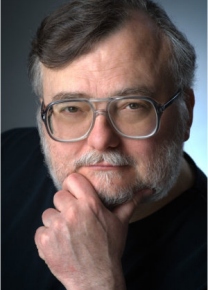
S.M. StirlingInterviewOriginally published February 2003 in 3SF |
|
Interviewed by Steven H Silver
S.M. Stirling began publishing with the novel Snowbrothers in 1985. His subsequent career saw the publication of numerous novels and short stories, sometimes in conjunction with other authors (The Ship Who Fought with Anne McCaffrey, The Rising, with James Doohan, and many others) as well as solo books and series (The Domination of Draka series, the Island series). His most recent solo novels, The Peshawar Lancers (2002) and Conquistador (2003) are stand-alone novels, both of which play with the rules of alternate history.
The Peshawar Lancers posits a world in hich a comet strike in the nineteenth-century has rendered much of Europe, Russia, and North America uninhabitable. The British Empire has relocated to India where the action begins in the early twenty0first century. Stirling has also written a novella, "Shakiri in Galveston," which uses the same background. He notes that he has "plenty [of ideas for a continuation of the series]. It's finding the time that's the problem! Ideas are easy. I have a round dozen well-developed outline. I haven't gotten around to yet. It's the writing that's hard."
Although Stirling's point of divergence for The Peshawar Lancers is set in the past, the novel itself is set in the future because "I wanted to reserve the p.o.v. [point of view] character's father for a possible sequel."
Stirling's newest novel, Conquistador, is set in a world in which a gate has been found between the California of our world and a similar California in which Europeans have not discovered America. "I've been wanting to write this for about twenty years, although it's a very different novel now from the one it would have been then -- more history under the bridge, and I flatter myself I've also learned a fair bit of technique since then. Other things kept getting in the way.
"The settlement of the Americas, and the rise of what was to become the United States, are the pivotal events that started the modern age; anyone thinking about alternate history has to have considered a few alternative Americas. I wanted to play with the idea of people at a more advanced stage of development making the Great Discovery; and since someone was going to duplicate Columbus' feat pretty soon anyway, that meant a crosstime story rather than a straight AH. It also enables me to play with the idea of how much benefit people would get from being able to know the consequences of certain decisions in advance."
When asked what is different about the novel he wrote now and the one he conceived twenty years ago, Stirling noted, "I think my touch with character has grown more subtle since then, and I'm also inclined to write less gloomily."
Aa with The Peshawar Lancers, Conquistador has a point of divergence in the past, but is set in the future. This was done "mostly to help with the plot. Either to give enough time for the social/cultural changes I wanted to occur, or to het a character at the right age -- for example, in Conquistador I wanted the lead character to have certain experiences and be a certain age when the story began, which required a date within a few years of 2010."
Both The Peshawar Lancers and Conquistador are alternate histories. Stirling has previously published alternate history stories and novels, including the Draka books and the Island novels, the latter of which were nominated for the Sidewise Award for Alternate History. When asked if he fears that his readers will try to learn history from his alternate histories, Stirling notes "Against stupidity, even the Gods content in vain, and I'm not quite at that level out here in Consensus Reality."
On a related note, in the acknowledgements to Conquistador, Stirling quotes Niven's Law that "there is a tehcnical literary term for those who mistake the opnions and beliefs of characters in a novel for those of the author.
"The term is 'idiot'." Perhaps because of the virulence of the opinions espoused by so many of Stirling's cultures and characters, he seems to be tarnished with the brush of showing his opinions frequently. When asked how much of his own political leanings appear in his books, he claims, "a fair bit, tho' not necessarily where you'd expect."
"One of the basic points about writing speculative fiction (and reading it, for that matter), is that you have to be able to get inside the head of people (or aliens) who are not like you. This is one of the failings of contemporary SF and fantasty, on the whole., particularly when dealing with people who are outside the moral and political consensus of contemporary American culture.
"I detest the sort of story where, for example, you're in medievel-esque fantasy setting and it suddenly turns out that the protagnoist is a believer in the Rights of Man, and otherwise salonfahig to an early-21st century American intellectual audience.
"Harry Turtledove, by the way, shows how this should be done -- his characters include peeple like Jake Featherston, the fascist dictator of the alternate-CSA, and he's a person, with recognizable motivations, strengths, weaknesses, and so forth. A bad person, to be sure, but not a cartoon. His William Shakespeare in Ruled Britannia is a genuine 16th-century man, as well, without threatening audience identification. So it can be done."
Stirling also points out that "Steve Brust once told me that a fan came up to him and praised one of his Jhereg books, because it 'really stuck it to the Jews.' Since there's nobody in the book but not-human aliens and Magyars, this struck him as a little strange..."
On the other hand, it is interesting to note that most of the authors Stirling recommends as having a similar feel to his own work, "Harry Turtledove, Dave Drake, Lois Bujold, Elizabeth Moon, Joel Rosenberg, Walter Jon Williams, perhaps George Martin. Just off the top of my head," are listed in a discussion of favorite authors which can be found in Conquistador. On those occasions when Stirling still reads SF, these are the authors he reads "plus a good many others. I find I read more nonfiction since I went full-time as a writer, thought." When pressed for non-fiction titles which would shed light on his works, Stirling commented, "Oh, Lord, that's a difficult one! History in general, I'm afraid."
The Draka novels (Marching Through Georgia, Under the Yoke, The Stone Dogs, Drakon) depict a dystopian world in which malcontents created a racist, feudal civilization in South Afrida and have built up their power until they rule much of the world. This series garnered Stirling much attention and numerous fans. In a recent interview with Jane Lindskold in Science Fiction Chronicle, Stirling commented that he "probably won't be doing any more Draka books in the immediate future." In the past, however, he's referred to two titles, Unto Us a Child and Laughter of the Guns. Stirling now says "currently they're on indefinite hold, mainly for business reasons."
Fans, however, can dip into a recent anthology Stirling edited, Drakas!, which include stories from a variety of other authors about the Draka. Stirling "thought it would be fun, and a couple of people had enquired if I was going to do so. It was interesting to see the universe through others' eyes." In addition, editing the anthology "reminded me that the same facts seen through different eyes have a different 'flavor.' And since a real world is seen through billions of different eyes, to have the texture of reality, it needs to catch that quality."
Although Drakas! wasn't Stirling's first foray into editing anthologies -- he previously was involved with The Fantastic World War II and The Fantastic Civil War -- it was the first time he put together an all-original anthology. Stirling notes that "The 'Fantastic' books were mostly of material already published. I might editorialize someone in the future."
Another area in which Stirling has taken tentative steps is writing speculative fact articles, two of which appeared in issues of the 1980s anthology series New Destinies. Stirling doesn't dismiss the possibility of writing more non-fiction articles, "I'd be glad to write speculative fact if I didn't have so much fiction to write!"
Wiht Conquistador published, Stirling has returned his attention to the world of the Island series. "I have long-term plans for the world, certainly. As for what happens here...well, a novel titled Dies the Fire is under construction as we speak. It's a quasi-spinoff of the Island series, dealing with what happens 'here' -- actually what happened in the world the island of Nantucket left in 1988." Stirling also notes, "So far, the island series is my favorite, apart from what I'm working on right now." One of the reasons may be "Most of the worlds I've created are dystopias! As the saying goes, 'adventure' means ;somebody else in deep shit, far away.'"
"If I had to choose [one of his own worlds to inhabit], I'd go to the Island in the Sea of Time world, or The Peshawar Lancers as a second choice. The Island world ends up with a stable, progressive democratic social order; the Lancers world has the first two." The Island series would also be Stirling's choice for a mini series based on his works, although he sees The Peshawar Lancers or Conquistador as the best options for a film.
"Well, filmed science fiction is a 'collaborative' effort, and even that makes for more uneven quality, on the whole -- as do commercial pressures and the peculariar setup of Hollywood.
"The most fundamental difference is information density. A long novel, particularly one with a lot of internal dialogue, cannot be turned into a movie, even a three-hour one. It needs a miniseries. Dune is a beautiful illustration of why.
"A movie is equivalent to a short story or novella. The Conan movies would have been infinitely better if they'd taken a Howard novella and used that as a template."
A typical day of writing "starts after noon, and usually ends about 2:00-3:00 a.m. in the morning! Apart from that, it varies wildly. I'm a burst writer; long periods of research and thinking, and then short periods of wild typing."
Stirling can also be found posting on a variety of Usenet groups. Why does he spend his time there? "I ask myself that question sometimes...:-). More seriously, they just 'make me think'."
Although many of Stirling's novels require a lot of research, he points out "history and anthropology are my hobbies, so you might say I've been doing the research for 30-odd years. When an idea comes to me I move into intensive mode on it; that usually involves buying a lot of books on the area in question, which I can then deduct from my income tax."
"Did I mention I love this job?"
"Fairly often," he finds serendipity playing a role, notably discoveries which fit in so perfectly that you have to expand the scope or change the events of the novel. "'The universe is not only stranger than we imagine, it is stranger than we can imagine'." Stirling enjoys the research so much that he frequently elects to share background with his readers which couldn't be worked into the novel.
Including appendices with information "is a matter of 'why not?' I have the information there -- these are usually part of my own background notes. Some readers like them, and the others can skip 'em if they want. Alternate history should appeal simply as a story, but it has additional pleasures for those who find the historical minutiae fascinating. Of course, there's the perennial problem of just how much to insert into the actual text, but that's another matter; ditto the problem of people being blankly ignorant if you avoid the usual historical turning-points, the Civil War and WWII and so forth." In support of this, Conquistador has four appendices covering the names and locations of the "Thirty Families," demographics, a history of the protagnosti's family, and a history of the world.
While Stirling citied Turtledove's Jake Featherston as an example of a well-drawn villain, there are plenty of examples in Stirling's own writing of competent characters the reader loves to hate. "I keep in mind that everyone is the hero in his/her own story. Everyone has motivations, and very few think, as they wake up one morning: 'Oooh, I'm bad. I'm going to build a big black tower and hire some Orcs.' Even Sauron didn't think that way!"
As an author, Stirling controls the fates of his characters. "I'm occasionally surprised by a character's actions, as they well up out of whatever foetid pit, but it's more a matter of getting a 'no, he/she wouldn't do that'."
"I've been a full-time writer since 1988. Recently I've even been able to make a middle-class income."
THe primary purpose of science fiction is "competition for people's beer money, first and foremost. I detest literary hubris and the 'we are the unacknowledged legislators of mankind' syndrome."
"That said, science fiction does have some potential to make people think outside the box, and the contemplate the pace of change in the modern age. Ours is the first era when the eternal verities don't necessarily apply; for example, this the first decade in which the majority of the human race lives in cities, rather than the countryside -- the first decade since around 7000 BC that the majority of humanity aren't peasants. Looking to the future, we now are within shouting distance of the capability to alter 'human nature,' the biological foundation which underlies and constrains cultureal variability. Only science ficiton can deal with such possibilities."
Of course, the reason to spend your beer money on Stirling's books is "because they tell interesting stories about interesting people in interesting place. I hope!"
A frequent activity in SF fandom is to draw meaningful distinctions between fantasy, science fiction, and their various subgenres, many of which Stirling writes in. He notes that there are, in fact, differences in creating the worlds for the various types of novel.
"In a fantasy world, you're making up the laws of nature; in a science fictional one, you're allowed to modify the laws of nature; and in an alternate world, the laws of nature are the same but the events fell out differently. Of course, those aren't hard-and-fast distinctions; for example, the thing that fell out differently may be a modification of a natural law"
"In terms of actual genre, the distinctions are more ones of 'flavor' han absolutes."
"Alternate history shows, at best, the workings of causation and the role of chance and personal choice in history, and their relationships. By understandin what might have happened, and why, we understand what did happen better."
Stirling has lived in a variety of places, from Canada to France to Africa to his current home in New Mexico. These different locations have had an effect on his writing, "principally by showing me that the way we think, act, and see the world here in North America isn't the only possible way to do so, and getting it across in a fairly visceral fashion. Living in a country where just getting enough to eat is a real worry to most people is an eye-opener, for example -- and that was the case for most of humanity throughout most of history."
"A friend of our family was arrested by Idi Amin's men in Uganda, and driven out into the bush to be shot. He jimmied the lock on the trunk of the car (that was where they'd stuffed him) and then walked out 120 miles to the Kenyan border."
As noted, many of Stirling's short stories and novels have been collaborations with other authors. The list of people he has worked with includes Greg Bear, James Doohan, David Drake, Richard Foss, Dean ing, Holly Lisle, Anne McCaffrey, Shirley Meier, Jerry Pournelle, Jan Stirling, and Karen Wehrstein.
"Some are done in a spirit of jouissance, of playfulness. Some because they are suggested to me by publishers."
"The only absolutely common element [in all collaborations] is that both names appear on the title page."
"Some involved handling the keyboard back and forth, some involved one party doing a very detailed outline and the other doing the first draft -- Dave Drake does the best outlines I've ever seen, and was a real pleasure to work with -- and some were more a matter of taking a background and some suggestions and running with them. Some involved personal contact (I enjoyed Jerry Pournelle's faultless hospitality several times) and some didn't."
Two of Stirling's stories are bylined as by Stirling and his wife, Jan. Despite the limited "official" recognition, "Jan reads everything I write while in profress, and makes suggestions. Perhaps everything I've written since 1988 should be a 'Jan & Steve' Stirling book!"
"More seriously, living together makes collaboration easier, of course. Jan has also published a few short stories on her own."
Stirling is also eager to play in the worlds created by his comrages in pen. In addition to opening up the Dominiation of the Draka for other authors, he has written stories about Pournelle's CoDominium, David Weber's Honor Harrington, Larry Niven's Known Space, and Anne McCaffrey's Ship Who universe. While Stirling enjoys creating his own worlds, "I don't think anyone can be entertained by a setting and not do a little daydreaming in it; not a writer, certainly. IN fact, tht's how most of us start -- imagining ourselves in our favorite authors' playpen. As for a favorite...that's hard to say. I've had a very weird sequel to Jack London's The Iron Heel in mind for some time, for instance; and it would be fun to redo [Edgar Rice Burroughs's] Barsoom."
He has written in more than just literary universes. At various times, Stirling has turned his quill to the worlds of the Terminators and Babylon 5. "It was a combination of 'I need the money' and finding the backgrounds interesting -- plus, of course, getting the invitation. I've turned down several requests to work with media projects because the settings bored me. If I didn't mind boredome, I would have stuck with law as a profession."
"On the other hand, I'm a professiona, not a prima donna; you have to be able to work consciously as well as in the white het of inspiration. Tht doesn't last for a whole book even when you're working with your favorite personal creations."
Novels form the majority of Stirling's published work "because novels make you a lot more money, mostly, and writing is how I meet my mortgage and buy food. I also lfeel more comfortable with novel-length, which is fortunate."
"Relative to the time and effort you put into them, short stories are just not cost-efffctive, and haven't been for a while; it's notable that these days writers start with novels and go on to short stories later, rather than vice-versa, which used to be the pattern. I came in right on the cusp of the change, in the early 1980's -- my first sale was a short story, but my second was a novel, and the sales were within a month of each other.
"Interestingly enough, I got a call from the editor of the short story; he thought the ending was ambiguous. I didn't and we talked around it for a while before I realized I hadn't sent the last page...
"I also did my first novel on a manual typewriter."
Stirling re-reads his novels, "but only occasionally. One per year, perhaps. Not counting several rereads just after they're finished, which helps with the decompression process." He is unembarassed by the writing or views espoused in those earlier endeavors. "I've improved, I think, and widened my knowledge base, but I like everything that made it in to print. Thank God for editors!"9:35 AM 12/29/2025
Like many if not all authors, Stirling is looking beyond his current project. "In the Time of the Red Death will probably be published in about two years; my agent is negotiating with it (and some other proposals) right now. THe premise is a 'wipe-the-deck' virus striking in the 18th century, when HIV and smallpox exchange genes in the hold of a slaver off the Guinea coast. Precursors of HIV were around in the eastern Congo at that time; captives from that area were being traded to the Atlantic coast; and viruses do exchange genes. What if these factors combined in the worst possible way?"