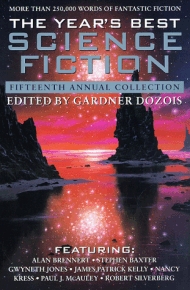
THE YEAR'S BEST SCIENCE FICTION: FIFTEENTH ANNUAL COLLECTIONEdited by Gardner DozoisSt. Martin's Press0-312-19033-6623pp/$17.95/June 1998 |
|
Reviewed by Steven H Silver
In his lengthy summation of 1997, Gardner Dozois begins by taking a shot at rival Best of Year anthologist David Hartwell by stating that "Doomsayers continued to predict the imminent demise of science fiction. . . with gloomy, headshaking, I-told-you-so-but-you-wouldn't-listen-to-me relish. . . ." Dozois then goes on to explain why, despite falling sales figures and mergers he feels science fiction is alive and well. However, as I pointed out in a review of Hartwell's anthology, Dozois's definition of science fiction is much more inclusive than Hartwell's.
The remainder of Dozois's summation looks at the various aspects of the sf field: magazines, books, anthologies, films, etc. Dozois points out what he felt were the strengths and weakness of each area, which can provide good fodder for a debate. After reading Dozois's take on the film "Fifth Element," I wonder if there are two films with that title (and shudder at the prospect). One new thing Dozois did in his introduction is to include a listing of some of the science fiction websites, both fiction and news-based, which can be found on the web.
Once I finish reading Dozois's summation each year, I find myself doing some number crunching. How many of the stories first appeared in Asimov's, the magazine Dozois edits (9 out of 26 this year). Looking at the source material this year reveals few surprises, although the surprises that are there are interesting. Only one story comes from Analog, but four are from Science Fiction Age. The big four magazines (those three, plus F&SF) contributed 16 of the stories in the anthology. The biggest surprises are four stories which do not come from traditional sources.
Two of the stories, Nancy Kress's "Steamship Soldier on the Information Front" and Dave Marusek's "Getting To Know You," come from a British anthology entitled Future Histories. This is a much talked about book which few people have seen since only a limited number were published and distributed, not to the trade, but to the British telecommunications industry. Dozois has provided a service in reprinting two of the stories in The Year's Best Science Fiction. Based on these works, with luck a general publisher (both in the US and the UK) will purchase reprint rights to the entire anthology.
The other surprise were stories by Simon Ings's "Open Veins" and Sean Williams and Simon Brown's "The Masque of Agamemnon." Both of these pieces were originally published on-line, the first in the recently defunct Omni On-Line, the latter in the continuing Eidolon, an Australian venture. Because of their electronic format, I have a feeling these stories have had a much smaller audience than they warrented, and it is nice to see that Dozois, whose anthology usually only draws from the usual suspects, is willing to look off the beaten paths.
Dozois has also included one of my favorite stories from the year, the Hugo and Nebula nominated "The Undiscovered," by William Sanders. On the surface, this story examines the idea of Shakespeare lost in the wilds of North America and writing Hamlet for a native American tribe. On deeper inspection, it examines the role and interpretation of art across cultural boundaries.
James Patrick Kelly's "Itsy Bitsy Spider" presents an odd mix of nostalgia with a quest for identity as Jen Fancy visits her estranged father in a fantasy world based on Beatles songs only to discover a robotic version of herself taking care of her aging father. Although Jen has no desire to be a part of her father's life, she is disturbed to discover how easily she seems to have been replaced.
Dozois's decision to represent a variety of types of science fiction can be seen by his inclusion of Bill Johnson's quixotically name "We Will Drink a Fish Together. . . ," which places an alien ambassador in a backwater Dakota town reminiscent of Twin Peaks, Washington or Cecily, Alaska right next to Stephen Baxter's hard sf alternate world story "Moon Six." Howard Waldrop's "Heart of Whitenesse," a journey up the Thames in the manner of Joseph Conrad, is another example of how far fiction can be from spaceships and planets and still fall into the category of science fiction.
Dozois's anthology continues to be the leader in a field which has, admittedly, little competition, currently only going head to head with David Hartwell's three volume series. Dozois's anthology tends to include a wider range of speculative fiction than Hartwell's anthology does in addition to Dozois's insightful summary of the previous year's science fiction and an extensive recommended reading list which Hartwell doesn't provide.
Robert Silverberg Beauty in the Night Paul J. McAuley Second Skin Nancy Kress Steamship Soldier on the Information Front Greg Egan Reasons to be Cheerful Stephen Baxter Moon Six Bill Johnson We Will Drink a Fish Together. . . Peter F. Hamilton Escape Route James Patrick Kelly Itsy Bitsy Spider Alastair Reynolds A Spy in Europa William Sanders The Undiscovered Alan Brennert Echoes David Marusek Getting To Know You Gwyneth Jones Balinese Dancer Robert Reed Marrow Howard Waldrop Heart of Whitenesse Michael Swanwick The Wisdom of Old Earth Brian Stableford The Pipes of Pan G. David Nordley Crossing Chao Meng Fu Greg Egan Yeyuka Carolyn Ives Gilman Frost Painting Walter Jon Williams Lethe Geoffray A. Landis Winter Fire Ian R. MacLeod Nevermore Simon Ings Open Veins Ian McDonald After Kerry Sean Williams & Simon Brown The Masque of Agamemnon John Kessel Gulliver at Home Gregory Benford & Elisabeth Malartrez A Cold, Dry Cradle
Purchase this book from 
Return to |
Thanks to |