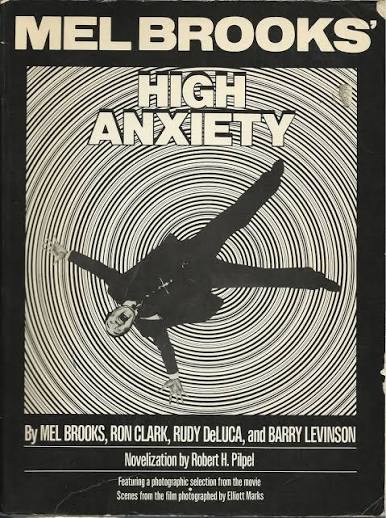
HIGH ANXIETYBy Robert H. PilpelGrosset & Dunlap0-448-14575-8151pp/January 1977 |
|
Reviewed by Steven H Silver
High Anxiety, Mel Brooks's affectionate parody of Alfred Hitchcock movies, may not be his best known film, but the novelization of the movie, written by Robert H. Pilpel, is easily the best novelization of one of Mel Brooks's films. Pilpel took the movie and tried to create a novel that stands on its own, and mostly succeeds by adding new dimensions to it.Dr. Richard Thorndyke, played by Mel Brooks, is the main character in the film. He also provides an audience stand-in, letting the viewer see the shenanigans taking place in The Psycho-Neurotic Institute for the Very, Very Nervous. In the novelization, Pilpel not only keeps Thorndyke as the main character, but writes the novel in the first person, so Thorndyke is no longer a stand-in for the reader, but the reader is actually Richard Thorndyke. While this does cause some issues when there are important scenes that Thorndyke was not witness to, Pilpel is able to handle those by shifting, briefly, to an omnipotent point of view, indicated by italics in the text. The use of first person, allows the reader into Thorndyke's thought processes and allows his memories to provide greater background to the character. Rather than describe the effects of "high anxiety" on him, Pilpel shows the impact on Thorndyke with sentences that are written in a way to induce anxiety and breathlessness.
One of Pilpel's innovations in writing the novel is the inclusion of brief backgrounds for each of the characters after they are introduced, almost as if the reader were privy to a psychiatric evaluation of the characters. This also allows Pilpel a quick and easy way to give the characters depth. In the film, Brophy (Ron Carey) is Thorndyke's chauffeur and an amateur photographer with an inability to lift heavy objects. In the novel, we learn of his love for the Brooklyn Dodgers and how his enjoyment of photos taken by Barney Stein (the official team photographer) led Brophy to photography, as well as how he decided to become a chauffeur. Pilpel provides these insights for all the major characters.
The fact that for all the zaniness of the film, the plot holds up in the printed version indicates that High Anxiety is more than an extended riff on Alfred Hitchcock. Brooks and his co-writers, Ron Clark and Rudy Le Luca, knew what they were doing and carefully built a film that worked on multiple levels. While the jokes may not land as hard in the novelization as they do on the screen, most of them are successful, and in at least one case, Pilpel provides a payoff for a joke that is missing from the film.
Many of the Mel Brooks movies from the 1970s and 1980s were novelized, although two of them, Silent Movie and History of the World, Part I, were more photo books than true novelizations. Of those six books, High Anxiety is the one that stands on its own the best and actually brings an added dimension to the film.
| Purchase this book |
|
|
Paperback |