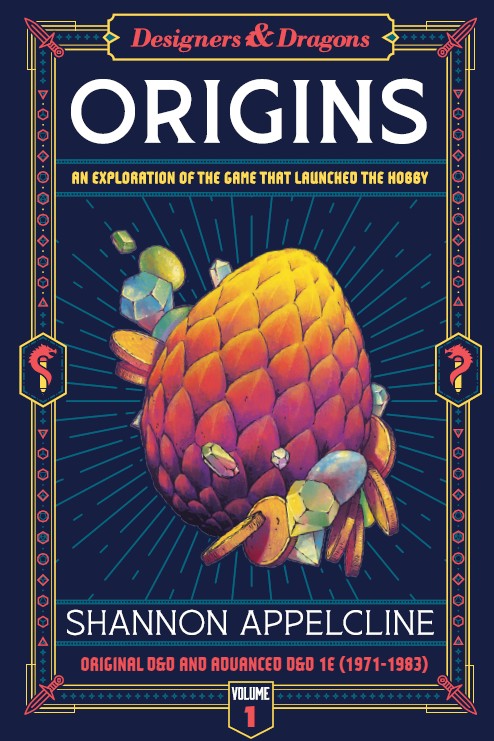
DESIGNERS & DRAGONS: ORIGINS, VOLUME 1By Shannon AppelclineEvil Hat978-1-61317-216-2380pp/$16.99/August 2026 |
|
Reviewed by Steven H Silver
I haven't really played Dungeons & Dragons since late 1980s, although I played pretty heavily beginning in 1980, so I approached Shannon Appelcline's latest project, Designers & Dragons: Origins, Volume 1 with a sense of nostalgia. Although my group started out with the Holmes Box set, we quickly moved to AD&D, with each member of the group purchasing one of the three available core rule books. Although we mostly played self-designed dungeons, we did pick up modules to use for ideas, and occasionally to play. In this volume, Appelcline looks at each of the TSR products issued as part of the original Dungeons & Dragon game and the Advanced Dungeons & Dragons game up to 1983.The volume is compiled in mostly alphabetical order, exploring each original D&D and AD&D product published by TSR from 1971 through 1983, beginning with Chainmail and continuing through the release of module T1-4: The Template of Elemental Evil. Each entry talks about the artwork and design of the product as well as the concept and where it comes from. The entries also have tropes Appelcline has identified that can be found in various products and each chapter ends with Appelcline pointing the reader to chapters that are of some associational interest to the chapter just read due to thematic or creator links.
Appelcline is not just interested in detailing the products TSR published during the period. As new creators are introduced to TSR, the chapters include substantial tangents outlining who the individuals are. This puts a face on the products, so James Ward or Leonard Lakofka are not just names, but actual individuals whose roles and relationship behind their names on the cover are fleshed out. This dovetails nicely to the hints Appelcline provides about the politics of working at TSR, although often those are merely hinted at rather than described, whether it is Gary Gygax's struggles with Brian Blume or the great purge of 1981. It also means that less well known creators or sidelined one, like Harold Johnson or Dave Arneson, are given their due.
The book is clearly not meant to be read straight through, but rather dipping in and out to explore specific modules, books, or accessories. This means that reading straight through reveals numerous redundancies in the text. Often this repeated information relates to the events occurring behind the scenes at TSR, but also could discuss the innovations taking place in the modules or rules books themselves. This issue would be less obvious when using the books for reference or dipping into them to read about specific products.
Each chapter also opens with a color reproduction of the works' covers, which gives a strong reminder of the item for those who are familiar with it. In the design and artwork section, however, Appelcline often refers to the frontispiece, interior illustrations, maps, or back cover art, which the reader may not have access to. The lack of inclusion of those pieces is understandable from a licensing and copyright point of view, but it can leave the reader wanting to find the artwork discussed when it isn't readily available.
As the name indicates, Designers and Dragons: Origins, Volume 1 is only the first book in a series which runs to four volumes, with subsequent volumes exploring the AD&D products from 1983-1988 (I2: Tomb of the Lizard King , to FR7: Hall of Heroes), Dungeons and Dragons from 1977-1987 (The Holmes box through the Immortal box), and 1987-1995 (DA1: Adventures in Blackmoor to AC1011: Poor Wizard's Almanac II & Book of Facts. While this first volume explores the creation of the game, the founding of TSR, and the establishment of both, the future books will show the expansion of the game. And reading this volume certainly makes we want to dig out my old AD&D books and modules to refresh my memory of the magic they introduced.
Return to