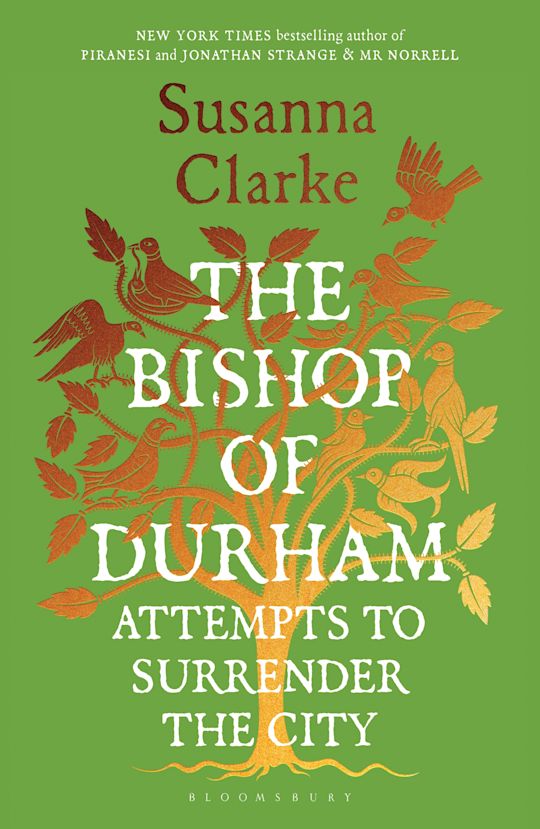
THE BISHOP OF DURHAM ATTEMPTS TO SURRENDER THE CITYBy Susanna ClarkeBloomsbury Circus978-1-037-20390-996pp/£10.99/October 2026 |
|
Reviewed by Steven H Silver
Ranulf Flambard was a Norman who served William I and his son, William II. In 1099, William II named Flambard to the bishopric of Durham. The following year, after William's death, Henry I had Flambard arrested and the bishop became the first person held prisoner in the Tower of London, although he was also the first person to escape the Tower. He was briefly removed as Bishop of Durham, but eventually reappointed and returned to Durham in 1106, focusing after that time on his bishopric rather than politics. In Susanna Clarke's The Bishop of Durham Attempts to Surrender the City, Flambard is the de facto leader of the city when it is captured by the foreces of fairy in this novella which is set centuries before the events in Jonathan Strange & Mr. Norrell.This short book begins with the fairy hordes taking over the North of England in 1110. One of the last cities to hold out against them is Durham, until Flambard realizes he is facing supernatural forces and the situation is hopeless. He travels to the New Castle upon Tyne, where the newly crowned King of the North resides. Once at the castle, Flambard finds himself facing a series of challenges to determine who the actual King of the North is as various people meet with him to accept his surrender. Not stated explicitly is that there is a power struggle occuring at the castle and a wrong choice by Flambard has the potential to change the balance of power and the future of magic in England.
Clarke's depiction of Flambard is on an astute man who understand what needs to be done in order to preserve his own position and isn't afraid to do it. At the same time, he is deliberative, not allowing himself to be rushed into making a decision which may prove detrimental to himself. On the other side of the coin is the King of the North, not yet known as the Raven King. A young boy who does not speak any English, he remains a mystery for much of the book, hidden behind his scheming courtiers, advisors, and wife. Thomas de Donville, the queen, and Nicol, are less well drawn, presented more as obstacles and puzzles for Ranulph, a purpose which they serve admirably.
The Bishop of Durham Attempts to Surrender the City offers a glimpse into the earliest days of magic in England, when both the humans, represented by Flambard, and the fairies who have taken over the North, represented by the King, are trying to figure out what the new situation means and how they are meant to interact with each other. Despite the conquest of the North by the fairies, Flambard understands that if they are only seen as enemies humans would never be able to live in peace with them, and so he offers his advice and service to the King, who is at a loss for what to do next and is being held a practical captive by those around him.
As with her previous novella, The Wood at Midwinter, Clarke is able to create an evocative setting in a limited space, its ties to the larger world of Jonathan Strange & Mr. Norrell adding to its ambience, but knowledge of which is not necessary for the reader to get lost in the world of twelfth century County Durham and Northumberland. A puzzle story, it offers glimpses into the wider world around it as well as that world's future, perhaps offering a promise of future works.
| Purchase this book |
|
|
|
|
Hardcover |
Kindle |
Audio book |