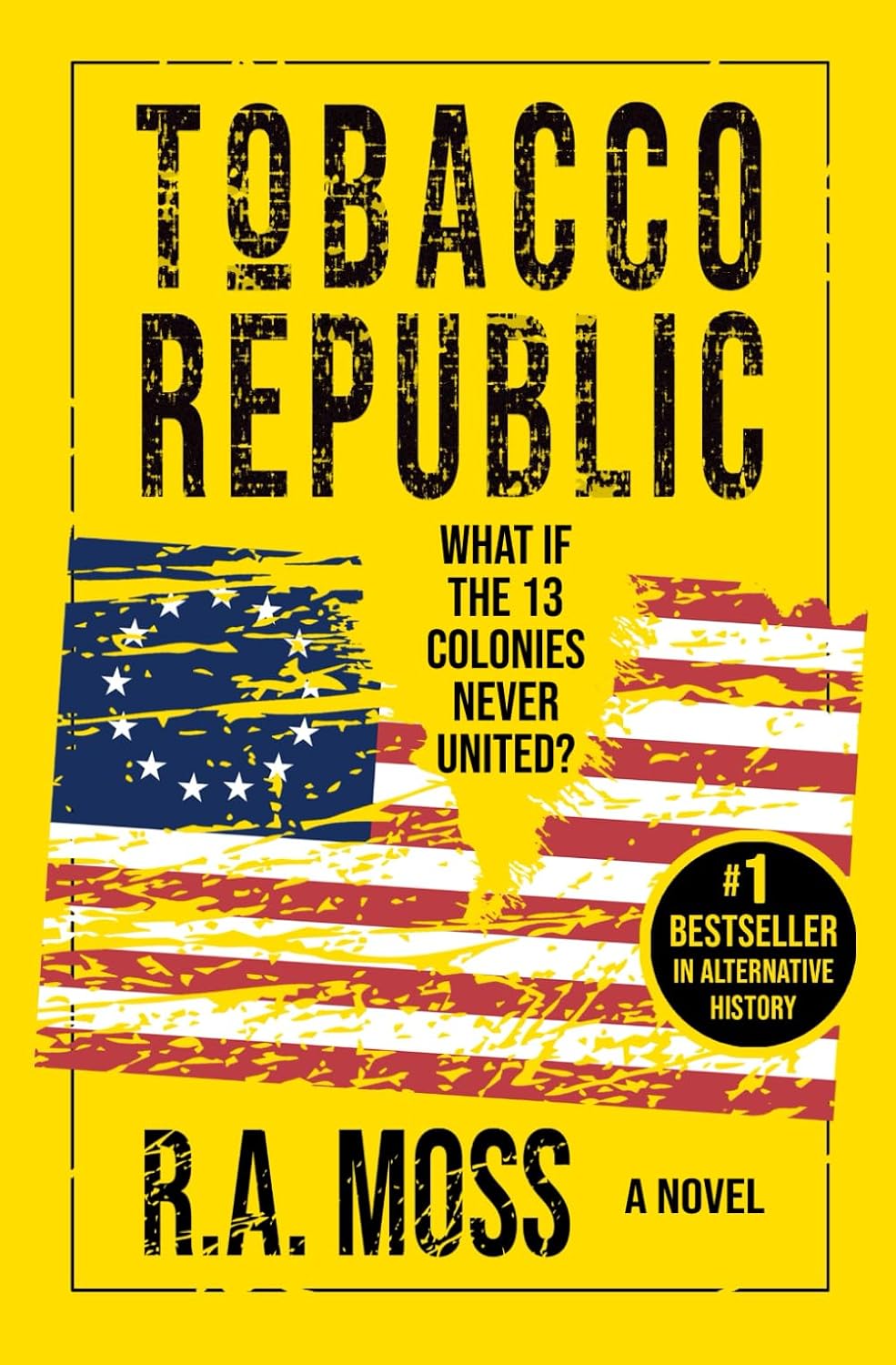
TOBACCO REPUBLICBy R. A. MossBeck and Branch979-8-9926-6820-9262pp/$14.99/August 2025 |
|
Reviewed by Steven H Silver
In the world of R. A. Moss's Tobacco Republic, the British colonies chose to form thirteen independent countries rather than unite in a single political entity, much to the chagrin of Thomas Jefferson, who fought for unity. Two hundred and fifty years later, Massachusetts has swallowed up all of New England and Pennsylvania has taken over Maryland, Delaware, and New Jersey, leading to an uneasy truce with Virginia to their south. Moss's story focuses on a Pennsylvanian spy, Brody Linn, who is trying to head off a new hot war between Pennsylvania and Virginia, and Olivia Braxton, the military liaison to Virginia's Paris embassy.Linn travels to Paris in an attempt to discover who has been sending a French explosive called bloom to the Virginians. His time to find the culprits is limited because Pennsylvania is already planning a raid on Virginia which will spark off another hot war. Braxton, on the other hand, is working with a German separatist movement that wants to blow up the Arc d'Triomphe to spur their own revolt against their French overlords. Naturally, their paths cross and, despite coming from enemy countries, Linn and Braxton find themselves in an uneasy alliance to avoid the coming Pennsylvania-Virginia war.
While Linn and Braxton's adventure takes place over the course of ten days (each a chapter of its own), Moss intersperses historical chapters showing how the Britannic countries of North America developed, occasionally showing Braxton of Linn's ancestors, but also indicating a much more volatile world. Virginia President Jefferson finds himself deposed by his rival, George Washington. Later, a socialist Pennsylvania is seen as having a revolving door of leadership.
Moss handles moving back and forth between the present and the past well so it doesn't cause the story to bog down. Similarly, when he is describing the action in the present, Braxton's sections are written in the first person and Linn's sections are in the third person to help differentiate them from each other. If their relationship seems a little too telegraphed at times, it is only a minor issue. Perhaps a bigger issue is that Moss seems to jump over what should have been the climax of the novel, bringing his characters up to the point and then suddenly dealing with the aftermath without actually showing how they solved the problem he set for them.
Moss builds a complex, if not entirely consistent world where alliances, both national and personal, are forged out of necessity and abandoned for a variety of reasons. His characters are products of their cultures, but are able to overcome, or at least put aside, their differences when they realize doing so may be for the greater good and may be what their countries need, even if it isn't what their countries leaders desire. Although Moss focuses on the the actions of two individuals, he clearly shows the consequences their actions have for the world at large, offering a final chapter set several years in the future which allows him to show the changes they wrought based on the world he methodically built up.
| Purchase this book |
|
|
|
Paperback |
Kindle |