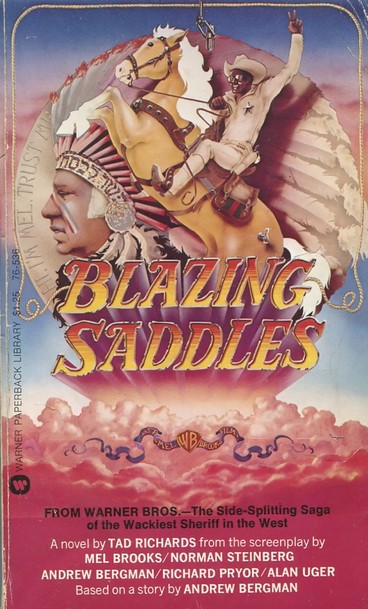
BLAZING SADDLESBy Tad RichardsWarner Books0-446-76536-8176pp/$1.25/March 1974 |
|
Reviewed by Steven H Silver
When Mel Brooks released the film Blazing Saddles in 1974, the only way to see the movie was to head to the movie theatre. There were no video tapes, DVDs, or streaming services. If you wanted to revisit the world of Bart, the Waco Kid, and Hedley Lamarr, you had to go to another showing at the theatre. Well, there was another way. A novelization of the movie was released the month after the film, written by Tad Richards and based on the script for the movie. This book gave a fan the chance to experience the plot and characters of Blazing Saddles, if not the visual aspect or timing aspects of the movie.Richard's book remains pretty close to the film, starting with the railroad workers building the line and Bart and Charlie winding up in quicksand and ending with Bart and the Waco Kid riding off in to the sunset. No attempt to flesh out the characters or provide additional back story for them occurs and with a few minor exceptions, there are no scenes that do not appear in the movie. Many of the scenes feel truncated because the filmed scenes were more action-related and Richards' description of that action feels rather sparse. This is particularly noticeable in the climax, which doesn't feel rushed, but does feel almost like an outline rather than a description of the action.
In the 1982 film My Favorite Year, which was produced by Mel Brooks and co-written by Blazing Saddles writer Norman Steinberg, the character Alan Swann states, "Dying is easy. Comedy is hard." Richard's book is an example of comedy being hard. While the film Blazing Saddles is listed as number six on AFI's funniest films of all time, much of the humor fails to make its way into Richards's book. Part of the problem is that so much of the humor of Blazing Saddles comes from the timing and delivery rather than the words themselves. When seen on the page in black and white, the words fall flat. Similarly, Richards's description of action scenes is sparse. The visual gag of Bart's parents' wagon is rendered "The solitary, tattered little Bart family wagon turned in little circles, several hundred yards away from the main wagon train," which hardly captures the scene in the film.
The text is fleshed out by a sixteen-page section of black and white movie stills showing scenes and details from the movie. Provided without context, they (mostly) are laid out in order to give the reader a feel for the look of the movie. At least a couple of the pictures are taken from scenes which did not make the final cut, which provides an extra to the book. Similarly, Richards's text includes a scene which is a tribute to the Marx Brothers' film The Big Store, which was either not filmed or cut from the movie, but is one of the few scenes in the book not from the movie. Finally, a stylistic decision for the book includes highlighting certain words (or sound effects) with a much larger type font than the majority of the text, which offers visual variety and a comic-bookish feel to those sections.
The novelization of Blazing Saddles is not replacement for the movie, especially in this day of easy to watch home video. It offers little insight into the film and removes much of the humor that makes Blazing Saddles a classic. Although Richards's addresses the main theme of racism in the book, like the humor, it is a watered down treatment and the prejudices Bart needs to face and overcome, and the ridicule the film aims at the bigots, almost seem an afterthought in the novelization.
Purchase this book

Paperback
Return to