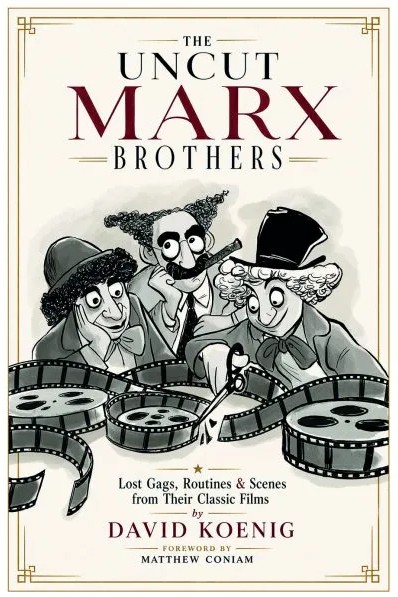
THE UNCUT MARX BROTHERSBy David KoenigBonaventure Press978-1-937878-32-0312pp/$29.95/October 2026 |
|
Reviewed by Steven H Silver
Between 1929 and 1949, the Marx Brothers released thirteen films, beginning with The Cocoanuts, which was adapted from one of their stage plays, and ending with Love Happy, which was initially conceived as a solo film for Harpo, but eventually grew to include Chico and Groucho. David Koenig is a life-long Marx Brothers fan who began looking at earlier scripts for the various movies to discover how much they differed from the final films and shares his research in The Uncut Marx Brothers: Lost Gags, Routines & Scenes from Their Classic Films.Koenig devotes a chapter to each of the Marx Brothers thirteen films, discussing the circumstances under which they were made, including any development of the scripts, which could be as "simple" as adapting stage plays for the first two films or for Room Service, to struggling to figure out what the plots should be. Along the way, he visits concepts that were tossed aside, either permanently or until a later movie found a place to use a gag. Koenig's research into the various versions of the scripts allows him to recreate scenes which were never filmed, and which may never have been seen by the Marx Brothers. A measure of the writer's success is whether the lines Koenig reproduces can be read in Groucho or Chico's voice, whether or not the lines were funny.
At its best, The Uncut Marx Brothers reads like missing sequences from one of the Marx Brothers films, which is not a surprise. Where it doesn't read like a Marx Brothers movie, it shows the misfires and bad ideas which were considered for the films, but didn't make it. As Koenig discusses the development of some of the movies, such as Go West, it is clear that the movie could have turned out much worse than it did. Similarly, some of the ideas considered and abandoned are shown to be so bad it is difficult to believe they were actually written.
Many of the chapters spend a good deal of time discussing the development of the movies the Marx Brothers eventually made. In many cases, the projects went through many versions and the book clearly shows how many different writers were involved, offering up conflicting plots and characters. The script for A Day at the Races is credited to Robert Pirosh, George Seaton, and George Oppenheimer, but Keonig tracks down versions of scripts and ideas contributed by Al Boasberg, Allan Boretz, Howard Dietz, Everett Freeman, Leo Gordon, George S. Kaufman, John Murray, Carey Wilson, with guidance from Irving Thalberg. The changes to the concept and script were tremendous and it would be interesting to have a chart to map out which features of the final film were introduced in which versions of the scripts that were considered.
There is a tendency to feel that alternatives that are lost may have been comedy gold, but in reality, many of the ideas which were jettisoned were not as good as what wound up on the screen. There was usually a good reason they were not used and the gems that were left behind are rare. Nevertheless, Koenig's book provides an insight into the creation of the films that has never really been explored, providing a look at how the brother's ad libs were allowed to find their way into the screenplays while also making it clear that the brothers were, in fact, delivering the lines written, not just by the credited screenwriters, but by an army of often overlooked writers.
| Purchase this book |
|