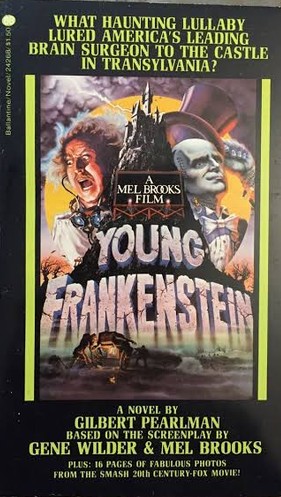
YOUNG FRANKENSTEINBy Gilbert PearlmanBallantine Books0-345-24268-8160pp/$1.50/November 1974 |
|
Reviewed by Steven H Silver
In 1974, Mel Brooks released two films which became classics of comedy. February saw the release of the western Blazing Saddles and December offered audiences the horror spoof Young Frankenstein. Both films starred Gene Wilder and featured Madeleine Kahn (and Liam Dunn). Both films also saw novelizations published to coincide with their release. The novelization of Blazing Saddles was written by Tad Richards, while Gilbert Pearlman adapted Young Frankenstein.While Richards's adaptation was pretty straightforward, Pearlman immediately offers new material in his version of Young Frankenstein. While the film begins with a short of hands taking a book from the dead Beaufort Frankenstein, the novel opens with the actual reading of Beaufort Frankenstein's will to his disappointed relatives who learn that they will only receive their inheritance if Beaufort's great-grandson did not become a successful doctor. The humor of this scene fits in well with the humor of the rest of the film, giving it the feel of a scene which was cut from the final film, rather than written specifically for the novel.
Later in the novel, Pearlman describes an encounter the creature has with a robber and also provides an expanded scene in which Helga's parents are concerned about her whereabouts before finding her in her bed following her encounter with the creature. These scenes are well integrated and offer a pleasant surprise for readers who are familiar with Brooks's film. Pearlman also gives Frederick Frankenstein's character a juvenile obsession with "big bazooms," (for both Inga and Elizabeth) which feels as if it fits in well with Wilder and Brooks's humor in the film. Pearlman handles the more familiar parts of the film well, offering a straight-forward view of the characters and their actions, which generally work, although the horses responding to Frau Blücher's name lose something when they are described rather than heard.
The book includes a sixteen page spread of stills from the movie, which give the reader a visual sample of the movie. Since the cinematography of Young Frankenstein and Brooks's attempts to reproduce the look of the 1930s Universal films is so important to the film, these images serve an important purpose in the book.
While Pearlman's book would allow readers in 1974 to revisit the story of Young Frankenstein, it doesn't, and can't replace watching the actual film, which is much easier in 2026. Reading the novel now feels like a throwback to an earlier time, when novelizations were simply written to recreate the film for the reader rather than add any new dimensions to the film. Pearlman has written a reasonably good adaptation of Young Frankenstein which adds a little to the film, but not enough to be worth tracking down.
| Purchase this book |
|
|
Paperback |